When you arrive at Oman's ancient city of Nizwa, surrounded by mountains and desert, you'll encounter an unusual piece of roadside sculpture: a giant Arabic coffee urn surrounded by silver-lined cups. This modern rendition of a traditional symbol of Arab hospitality could stand for Oman's intriguing combination of old and new. Long isolated from the rest of the world, Oman only recently began welcoming travelers inside its borders. But even as it has opened its doors to the world and brought modern improvements to the remotest villages, it has also retained many of its traditional desert ways. Along the coast, boatbuilders in small fishing villages still craft dhows by hand. Inland, Bedouins carve out their living on rocky terraces, their villages perched on the precipices of a yawning gorge.
Travelers could also see the giant urn as a kind of magic lamp beckoning them to one of the most exotic places in the world: to wild desert villages and palm-lined oases, where women wear black silk robes and brightly hued masks, and men wear ankle-length robes and colorful cashmere turbans. But for those who prefer the more comfortable pleasures a genie might offer, there are also luxurious tropical seaside resorts, with opportunities for scuba diving and fishing.
Although Oman is not for everyone, it is certain to charm those with an eye for natural beauty and an interest in Arabic tradition.
One of the oldest states on the Arabian Peninsula, Oman was once an important sultanate whose influence was felt as far away as Zanzibar and Pakistan (it sent an ambassador to the U.S. in the 19th century). Today its people reflect a mixture of African, Indian and Arabian influences. Its customs are shaped by those cultures, overlaid by a very thin veneer of British practices (the British were dominant in the area from the mid-19th to mid-20th centuries).
Oman doesn't boast the extraordinary oil wealth of its neighbor, the United Arab Emirates, but the standard of living is still much higher in Oman than in many other Arab countries. Roads, electricity, water, health clinics and schools have arrived in even the most remote mountain villages. The economy remains among the best managed in the region. Although the population enjoys some political representation through a consultative parliament set up after the Gulf War in 1991, the country remains essentially an autocratic monarchy in which the line between the state and the Omani ruling family is blurred.
Geography
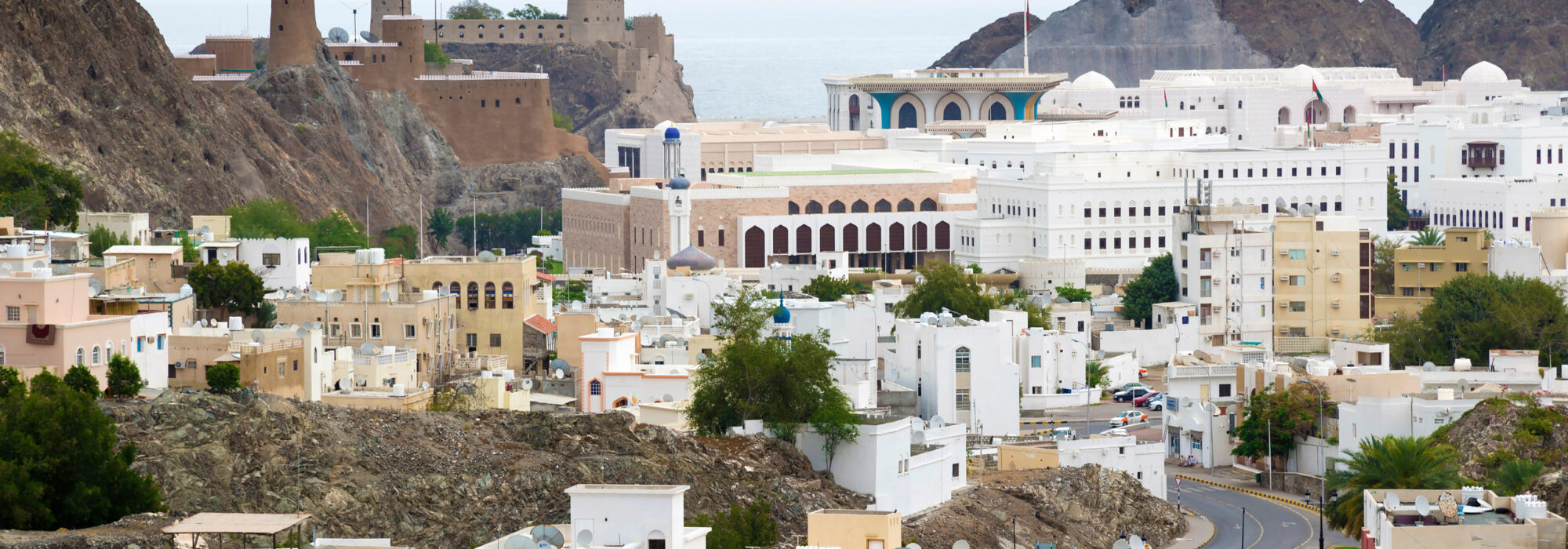
Vaguely boomerang-shaped, the Sultanate of Oman lies along the eastern edge of the Arabian Peninsula and occupies a land mass roughly equal to the U.S. state of Kansas. Its eastern side is bordered by the Gulf of Oman and the Arabian Sea. This coastline, which extends well over 1,000 mi/1,610 km, is remarkably picturesque and contains most of Oman's key cities and towns.
Beyond the western edge of Oman are the United Arab Emirates and Saudi Arabia. Yemen lies to the south. Spectacular spiny mountains in the northern and southern ends of the country enliven what is otherwise mostly a sparsely populated desert landscape.
History
Traces of ancient civilizations dating to the third century BC have been found around Oman, but the country's recognizable history really begins with the arrival of Arab tribes roughly 2,000 years ago. The state of Oman, founded by some of the earliest converts to Islam, was created in the eighth century AD.
Because the nation occupied a strategic position on the trade route between India and the West, European powers began to take an interest in Oman during the 1600s. In 1507, Portugal captured the capital of Masqat, but was expelled by 1650. The sultan of Oman began cultivating trade relationships with Britain, which quietly but significantly influenced Omani affairs for some three centuries.
Oman reached the height of its power and influence during the first half of the 19th century, under the rule of Sayyid Said bin Sultan. Alliances with the British government ensured military protection for Oman, allowing it to expand its territories and trade outposts. A second capital was established in Omani-controlled Zanzibar, which is about 25 mi/40 km off the coast of present-day Tanzania, and the nation also held sway in southerly parts of the Arabian Peninsula and coastal areas of modern Pakistan. By the 1850s, a crisis of succession led to a split in the Omani empire—one ruler controlled Zanzibar, the other took the Arabian lands—and the nation slid into a century of economic decline and political weakness. Tribes from the interior periodically mounted attacks on the rulers in Masqat. By the 1960s, Oman was closed to the outside world and economically stagnant.
That same year, Oman's current leader, Sultan Qaboos bin Said, staged a palace coup against his father, seizing power and starting the country on a modernization drive to educate the populace and build the nation's infrastructure. Tourism to Oman only began in the 1980s.
Snapshot
Oman's foremost attractions are desert sand dunes, 400-year-old forts, ancient ruins, beaches, mountains, oases, traditional bazaars, scuba diving, camel treks and Arab culture.
Oman will appeal to travelers who are willing to abide by laws and customs that may seem conservative and restrictive in order to see a relatively untouched country.
Potpourri
Of Oman's population of 2.9 million, some 600,000 are expatriates, and some of them are doing rather unusual jobs. During one of our trips, we met a Scot who was working as the chief repairer of bagpipes for the sultan's army band.
The country is home to the Arabian tahr, a rare variety of mountain goat, and large reserves of Arabian oryx.
As just one indicator of how undeveloped Oman once was, in 1970, it only had about 2 mi/3 km of paved road.
According to legend, Sinbad the Sailor departed for his seafaring adventures from the port of Sohar. The Seven Voyages of Sinbad the Sailor is a collection of travel-romance tales found in The Book of One Thousand and One Nights.
After years of bad blood, Oman and Yemen have finally established a permanent border. A paved highway now connects the two countries.
The workweek in Oman is Saturday-Wednesday.
The Sultan is a strong proponent of public cleanliness and hygiene, sometimes offering prizes to the country's cleanest towns. In 2003, Masqat was bestowed a Cleanest City award by the U.N.
Oman was converted to Islam during the prophet Muhammad's lifetime.
Women traditionally wear colorful garments from head to toe, leaving only the face and hands exposed. Women in rural areas wear leather or cloth masks (burkas).
Oman is one of the world's main producers of frankincense, which was valued as highly as gold in antiquity. It's also traditionally burned in new homes to ward off evil spirits.