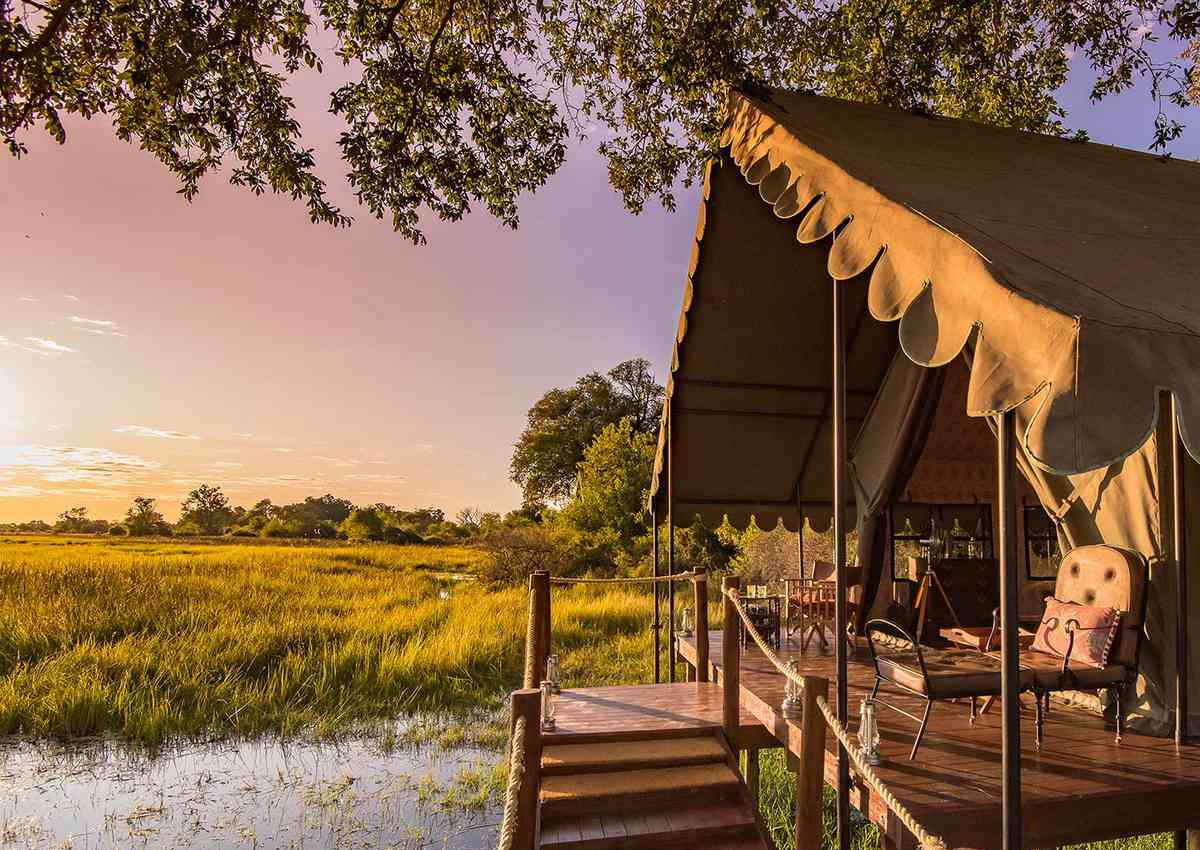
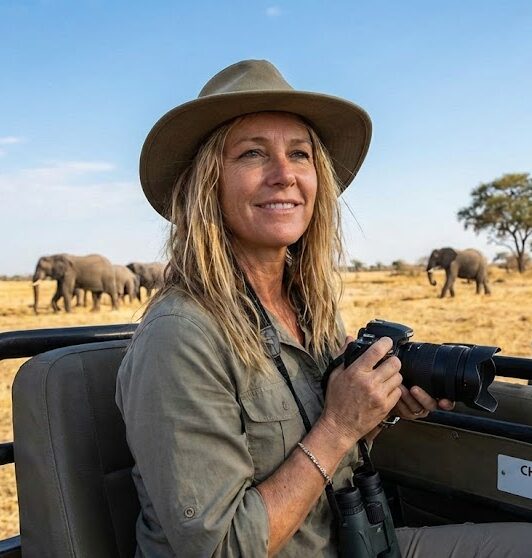
Botswana, Africa, with lots of wide-open spaces—and lots of wildlife to fill them—is one of the few remaining destinations in Africa where the adventuresome safari spirit still survives. Travelers on safari in Botswana get to see an ark full of animals in the wild: lazing in the waters of the Okavango Delta (Moremi Game Reserve), grazing on the grasslands of Chobe National Park (Chobe Game Lodge) and tracking the arid salt pans of the Kalahari Desert.
To protect Botswana's natural assets, government policy promotes low-volume, high-cost tourism. The country may have high travel fees, but Botswana travel rewards visitors with a plethora of colorful birds and large game—including lions, brown hyenas and cheetahs, ostriches and zebras, antelope and leopards. Accommodations can range from a tented riverbank campsite to a plush lodge.
Botswana can afford to discourage mass tourism because of its great mineral wealth. It is one of the world's largest producers of diamonds, and it has reserves of gold, copper and nickel. The country is also a large exporter of beef to the European Union.
More than 80% of Botswana's small population of 2.3 million lives in a scattering of towns and large villages, such as Francistown or the capital of Gabarone, leaving plenty of room for animals—and travelers—to roam the countryside unhindered.
Geography
Botswana is a landlocked country dominated by the Kalahari Desert in the south and west (more than two-thirds of the nation is desert). However, desert is something of a misnomer, as the Kalahari sands shelter numerous habitats and vast grasslands supporting a variety of animals. But apart from a few perennial springs, there is no surface water and scant rainfall.
The northeast is characterized by gently rolling tablelands interspersed with granite kopjes, or hills, formed of giant rocks balanced upon one another in sometimes fantastic formations.
In the northwest, the Okavango, the world's largest inland delta, forms a network of swamps and lagoons.
History
The nation was originally inhabited by the San people (also known as the Bushmen), then the Tswana, a Bantu group. In 1885, it became the British protectorate of Bechuanaland, mainly to ward off encroachment by the Germans from the west and Boers from the south.
The struggle for independence, which was achieved in 1966, was largely peaceful and democratic. Seretse Khama III was elected the country's first president, a post he held until his death in 1980. Since Khama's death, the Botswana Democratic Party has managed to maintain the majority in parliament and has continued to cautiously promote pro-Western policies.
Khama's son, Lt. Gen. Seretse Khama Ian Khama, took over as president in April 2008. He was one of the few southern African leaders to publicly denounce Zimbabwean President Robert Mugabe's actions during that country's 2008 sham elections.
Perhaps the most important event in Botswana's modern history was the discovery of diamonds in 1967. Diamond wealth has enabled the country to build up foreign currency reserves and maintain economic stability. In comparison to the rest of the African continent, Botswana remains an enormously wealthy and stable country. That stability, accompanied by multiparty democracy, has served as a model for sub-Saharan Africa.
Botswana's greatest problem today is HIV and AIDS—more than 1 in 3 people are infected. Life expectancy in Botswana dropped from an average of 65 years old in 1991 to 55 in 2001. However, the country has one of Africa's most advanced treatment programs, and antiretroviral drugs are available free of charge. In 2018, the World Health Organization raised the life expectancy back to age 65.
Snapshot
Wildlife viewing, bird-watching, fishing and desert camping are the foremost attractions of Botswana.
Botswana remains a country for the intrepid, adventurous traveler who is interested in superlative wildlife reserves and arid wilderness. Exploring the largely roadless wild area, however, requires plenty of time, patience and money—this is not a destination for those on a tight budget.
Potpourri
The country is Botswana, the people are Batswana, an individual is a Motswana and the language is Setswana.
Seretse Khama III, heir to the chieftainship of the Bamangwato people, met the Englishwoman Ruth Williams while he was studying in London. Their marriage was opposed by both Khama's uncle, the ruling regent Tshekedi Khama, and the British government, forcing the couple to live in exile in England for six years. The Bamangwato were infuriated by this banishment and protested vigorously. When Seretse Khama, still barred from chieftaincy, was allowed to return to his country in 1956, he devoted himself to politics, joining the protectorate's new legislative council in 1961. He became the country's first prime minister in 1965, and a year later, as the knighted Sir Seretse Khama, became Botswana's first president.
Sustainable big-game hunting is permitted on some private reserves; there is very little poaching in Botswana.
Stone Age villages and prehistoric beaches can be found in the vast salt pans of the northern Kalahari.
Water is such a precious commodity that the local currency is called pula, which means rain in Setswana. Rain and wealth are considered to be one and the same in Botswana.
Unlike most other African countries, Botswana's flag is dominated by a tranquil blue, a color intended to reflect the peaceful and calm nature of the people. Black-and-white stripes symbolize racial harmony. The blue also represents water.